


佩小姐的奇幻城堡
Levee breaches hit three areas in Henan, residents evacuated with no casualties reported_我的网站

一 | DEIR AL-BALAH, Gaza Strip -- The only thing worse than the screams of a patient undergoing surgery without enough anesthesia are the terror-stricken faces of those awaiting their turn, a 51-year-old orthopedic surgeon says.When the Israeli bombing intensifies and the wounded swamp the Gaza City hospitals where Dr. Nidal Abed works, he treats patients wherever he can — on the floor, in the corridors, in rooms crammed with 10 patients instead of two. Without enough medical supplies, Abed makes do with whatever he can find – clothes for bandages, vinegar for antiseptic, sewing needles for surgical ones. Hospitals in the Gaza Strip are nearing collapse under the Israeli blockade that cut power and deliveries of food and other necessities to the territory. They lack clean water. They are running out of basic items for easing pain and preventing infections. Fuel for their generators is dwindling.Israel began its bombing campaign after Hamas militants surged across the border on Oct. 7 and killed over 1,400 people, mostly civilians, and abducted more than 200 others. Israel's offensive has devastated neighborhoods, shuttered five hospitals, killed thousands and wounded more people than its remaining health facilities can handle.“We have a shortage of everything, and we are dealing with very complex surgeries,” Abed, who works with Doctors Without Borders, told The Associated Press from Al Quds Hospital. The medical center is still treating hundreds of patients in defiance of an evacuation order the Israeli military gave Friday. Some 10,000 Palestinians displaced by the bombing have also taken refuge in the hospital compound.“These people are all terrified, and so am I," the surgeon said. “But there is no way we'll evacuate.” The first food, water and medicine trickled into Gaza from Egypt on Saturday after being stalled on the border for days. Four trucks in the 20-truck aid convoy were carrying drugs and medical supplies, the World Health Organization said. Aid workers and doctors warned it was not nearly enough to address Gaza’s spiraling humanitarian crisis. “It's a nightmare. If more aid doesn’t come in, I fear we’ll get to the point where going to a hospital will do more harm than good,” Mehdat Abbas, an official in the Hamas-run Health Ministry, said. Across the territory’s hospitals, ingenuity is being put to the test. Abed used household vinegar from the corner store as disinfectant until the stores ran out, he said. Too many doctors had the same idea. Now, he cleans wounds with a mixture of saline and the polluted water that trickles from taps because Israel cut off the water. A shortage of surgical supplies forced some staff to use sewing needles to stitch wounds, which Abed said can damage tissue. A shortage of bandages forced medics to wrap clothes around large burns, which he said can cause infections. A shortage of orthopedic implants forced Abed to use screws that don't fit his patients' bones. There are not enough antibiotics, so he gives single pills rather than multiple courses to patients suffering terrible bacterial infections. “We are doing what we can to stabilize the patients, to control the situation,” he said. “People are dying because of this." When Israel cut fuel to the territory's sole power plant two weeks ago, Gaza's rumbling generators kicked in to keep life-support equipment running in hospitals. Authorities are desperately scrounging up diesel to keep them going. United Nations agencies are distributing their remaining stocks. Motorists are emptying their gas tanks. In some hospitals, the lights have already switched off. At Nasser Hospital in the southern city of Khan Younis this week, nurses and surgical assistants held their iPhones over the operating table, guiding the surgeons with the flashlights as they snipped. At Shifa Hospital, Gaza’s biggest, where Abed also worked this week, the intensive care unit runs on generators but most other wards are without power. Air conditioning is a bygone luxury. Abed catches beads of sweat dripping from his patients’ foreheads as he operates.People wounded in the airstrikes are overwhelming the facilities. Hospitals don't have enough beds for them. “Even a normal hospital with equipment would not be able to deal with what we’re facing,” Abed said. “It would collapse.” Shifa Hospital — with a maximum capacity of 700 people — is treating 5,000 people, general director Mohammed Abu Selmia says. Lines of patients, some in critical condition, snake out of operating rooms. The wounded lie on floors or on gurneys sometimes stained with the blood of previous patients. Doctors operate in crowded corridors filled with moans. The scenes — infants arriving alone to intensive care because no one else in their family survived, patients awake and grimacing in pain during surgeries — have traumatized Abed into numbness. But what still pains him is having to choose which patients to prioritize.“You have to decide," he said. “Because you know that many will not make it."___DeBre reported from Jerusalem.。
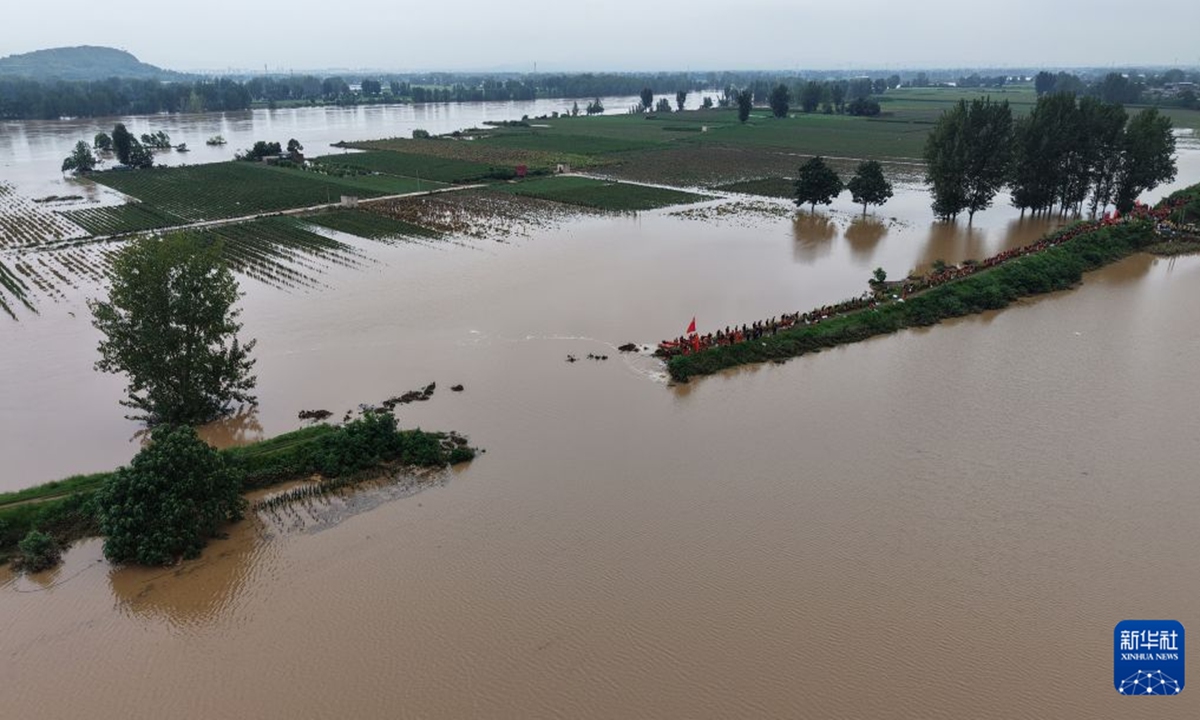
A total of 781 local residents have been evacuated due to a levee breach on the eastern bank of the Jialu River in Zhoukou at around 11 pm on Thursday, due to pressure from upstream inflows on the Jialu River and backwater from the Shaying River, the breach is about 30 meters wide, according to the Xinhua News Agency on Friday.
The Ministry of Emergency Management has dispatched 200 personnel from China Anneng Group, along with 110 sets of large engineering and rescue equipment, to Zhoukou, after the levee breach on the Jialu River, the ministry said on Friday.
The rescue force, equipped with powered pontoon boats, amphibious excavators, loaders and other heavy engineering machinery, arrived at the scene by 10 am on Friday and immediately began emergency response and rescue operations.
CCTV News reported that the breach flooded a hospital compound and a driving school in Zhoukou, with floodwaters reaching up to 1.5 meters deep.
After the breach occurred, Zhoukou's fire department mobilized 290 personnel from seven nearby brigades to the scene, deploying loaders, inflatable boats, motorboats and other rescue equipment to search for and evacuate stranded people area by area.
According to Henan Daily, another levee breach occurred along the left bank of the Beiru River in Jiaxian county, Pingdingshan, earlier at around 7 pm on Wednesday. The breach, measuring about 47.5 meters wide, prompted local authorities to evacuate 2,182 residents from six villages in two rounds. No casualties were reported, and all evacuees were properly accommodated.
According to an official notice from Yanling county in Xuchang, another levee breach occurred along the Qingyi River near Cangtou village on Thursday, as continuous heavy rainfall kept the river at high levels. Local authorities immediately launched an emergency response and organized evacuations and other risk-prevention measures. No casualties have been reported.
Global Times
。

二 |
Current article:http://s08u.ruidunguizanpaorangchongouxia.sbs/0fc/7u6xmmq.html
Published on:00:00:00
 黄仁勋再次演唱:摩尔定律不复存在
 水泵抽了5个小时 龙坞桥洞终于通了
 意大利足协:受疫情影响2020至2021年意大利球场门票收入几乎为零
 市委举行学习贯彻习近平新时代中国特色社会主义思想读书班暨市委理论学习中心组学习会议
 中伊副外长北京会晤,外交部:中方密切关注中东海湾局势,积极致力于劝和促谈
 2024中关村论坛“京港科技创新论坛” 暨第七届“京港青创杯”创业大赛北京选拔赛在京举办
 中金:钽铌行业供需格局重塑 战略价值重估
 (长征胜利90周年)四川黑水:从红军“筹粮熬盐”出发地到红色旅游热土,中国新闻网,(长征胜利90周年)四川黑水:从红军“筹粮熬盐”出发地到红色旅游热土
 维持巅峰!TA:阿森纳引援选择即战力,宝贵的稳定性千金难求
 不仅微软和谷歌,Verizon也在运行游戏流服务。
 午餐选择背后的经济学
 不愧是费多罗夫,两个问题如同“尖刀”,泽连斯基的回应苍白无力!,兵器观察员,原创 不愧是费多罗夫,两个问题如同“尖刀”,泽连斯基的回应苍白无力!